
Disorder at the Surface: Ultrafast Changes in La0.5Sr1.5MnO4
A new study on the quantum material La0.5Sr1.5MnO4 reveals that its response to light is more complex than expected. Using ultrafast X-ray pulses, researchers found that the material’s surface reacts differently than the bulk when its orbital order is disturbed. These results challenge the idea that light-induced changes happen uniformly and suggest that the path from order to disorder is shaped by local differences inside the material.
In certain materials, the electrons arrange themselves in a well-defined, ordered pattern. This internal order can influence everything from how the material conducts electricity to how it responds to magnetic fields. One example is La0.5Sr1.5MnO4, where the electrons of manganese atoms form such an ordered pattern, known as orbital ordering, leading to distinctive electronic and magnetic behavior that makes it a quantum material.
Researchers are increasingly interested in how light can be used to understand and control the orbital state of these materials. With the right kind of light pulse, it may be possible to switch or reshape their properties at incredible speeds. Therefore, understanding how these materials switch is an important step to making devices.
In many devices, surfaces of and interfaces between materials are known to play a major role in the device properties, but it has not been possible to measure how quantum materials change at the surface when switched at high speeds by light and only the average response over the whole crystal has been measured.
In this study, scientists asked if the average response measured to date accurate captures the processes that occur at the surface, which will be relevant for any device. Remarkably, they found that they did not.
To do this, they used an ultrafast X-ray laser to observe what happens when La0.5Sr1.5MnO4 is exposed to laser light. Instead of a simple response, they found a complex process in which disorder begins at the surface and spreads unevenly through the material.
Key Findings
- Ultrafast X-rays reveal that La0.5Sr1.5MnO4 responds to laser light in a non-uniform way
- Surface and bulk responses were separated (isolating surface dynamics from the orbital Bragg peak)
- The surface loses order faster than the bulk, driven by local distortions
- The transition is disorder-driven, not a smooth structural change
- These results challenge earlier models of photoinduced phase transitions
Shedding Light on Complex Behavior
To follow how the material changes after it is excited by light, the researchers used time-resolved X-ray surface diffraction at the SwissFEL facility in Switzerland. This advanced technique allowed them to record snapshots of how both the surface and bulk of La0.5Sr1.5MnO4 reacted within femtoseconds after being hit by a laser pulse. By carefully adjusting scattering geometry, they could separate the signal coming from the surface from that of the deeper layers, giving a clear view of how order and disorder develop in different parts of the crystal.
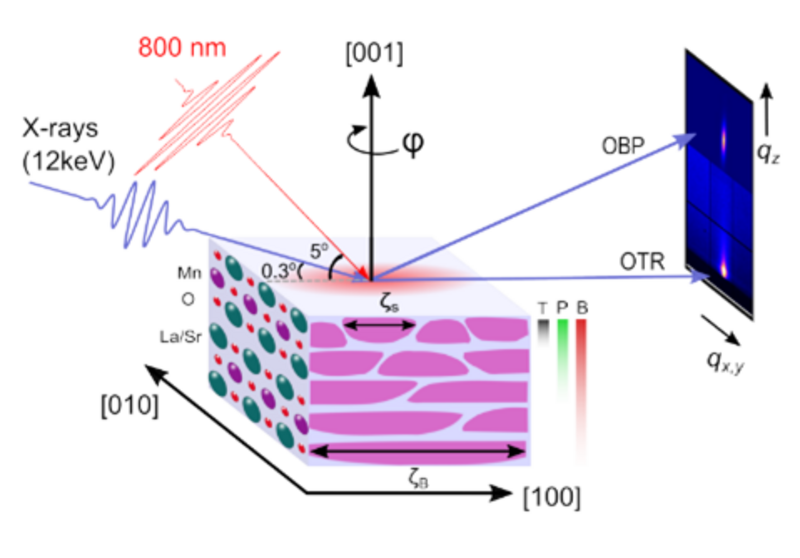
The results showed that the surface region loses its orbital order much faster than the bulk. At the surface, this order quickly broke down through small, irregular movements of atoms, a process called local distortion. In contrast, the inner layers remained relatively stable for longer.
These findings challenge earlier models of photoinduced phase transitions, which assumed a uniform transformation. They also point toward new strategies for using light to control materials in space and time, potentially allowing scientists to design devices where surface and bulk properties can be tuned separately for ultrafast electronics and quantum technologies.
How Did They Do It?
The researchers used ultrafast surface X-ray diffraction experiments to measure the surface and bulk response of La0.5Sr1.5MnO4 on the atomic scale for the first time.
- X-ray surface scattering is incredibly weak, and measuring the dynamics at the surface required high intensity X-rays that are generated by X-ray lasers.
- The results show that previous methods that measured the average response of the whole crystal can give the wrong picture for the atomic scale processes that occur.
Together, this method gave a detailed picture of how order breaks down in a quantum material after light excitation while distinguishing between surface and bulk.
Why does it matter?
Understanding how electrons and atoms respond locally is crucial for developing ways to control material properties on demand. This could lead to new strategies for ultrafast switching in electronic or magnetic devices, or even future quantum technologies where the speed and precision of control are key.
By showing that disorder and surface effects play a bigger role than previously thought, the study opens new questions about how to harness light to reshape complex materials in useful ways.
Interested?
You can explore the full study in Nature Materials. Otherwise, feel free to explore the other research topics we work on at iMAT.
[1] Ultrafast surface melting of orbital order in La0.5Sr1.5MnO4
Maurizio Monti, Khalid M. Siddiqui, Daniel Perez-Salinas, Naman Agarwal, Martin Bremholm, Xiang Li (李翔), Dharmalingam Prabhakaran, Xin Liu, Danylo Babich, Mathias Sander, Yunpei Deng, Henrik T. Lemke, Roman Mankowsky, Xuerong Liu (柳学榕), Simon E. Wall
[1] Ultrafast surface melting of orbital order in La0.5Sr1.5MnO4
Maurizio Monti, Khalid M. Siddiqui, Daniel Perez-Salinas, Naman Agarwal, Martin Bremholm, Xiang Li (李翔), Dharmalingam Prabhakaran, Xin Liu, Danylo Babich, Mathias Sander, Yunpei Deng, Henrik T. Lemke, Roman Mankowsky, Xuerong Liu (柳学榕), Simon E. Wall
If you are working on related materials or applications, we invite you to reach out to Simon Wall or to our Center Manager to discuss potential collaborations or shared research opportunities.